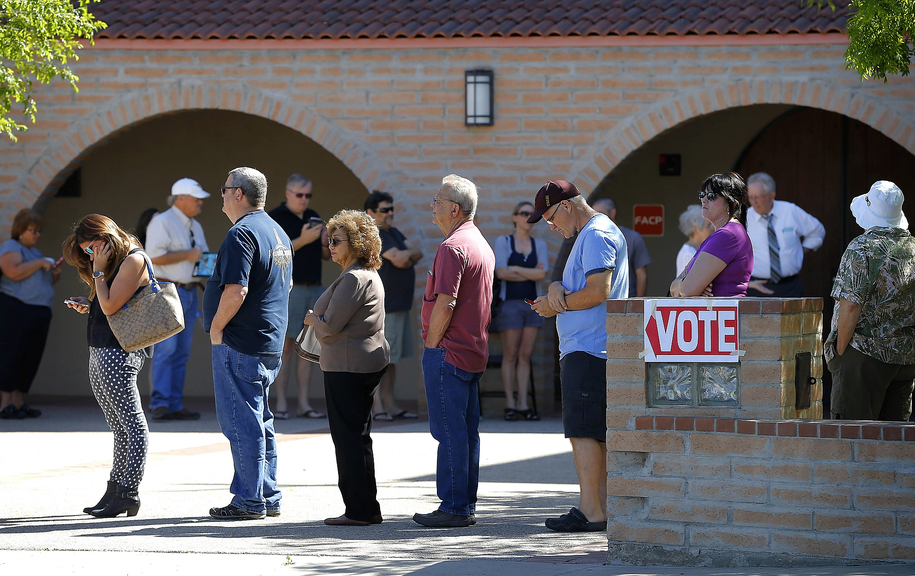
Voters wait in line to cast their ballot in Arizona in 2016.
Constitutional amendment would end Election Day drop-offs, gut active early voter list for 80% of Arizonans.
By Caitlin Sievers for Arizona Mirror
Republican legislators who have pushed for extreme, unpopular and unrealistic election law changes in Arizona have a “top priority” in the coming year that experts say will make voting more difficult for everyone.
The sweeping changes are needed, proponents say, to get faster results and soothe the belief among many conservatives that voting is rife with fraud, which has become dogma after nearly a decade of Republican politicians increasingly declaring elections are rigged when they lose.
Rep. Alexander Kolodin, a Scottsdale Republican and member of the far-right Arizona Freedom Caucus, authored House Concurrent Resolution 2001, which would amend the Arizona Constitution to do away with the active early voter list that automatically sends ballots to voters and cut off early ballot drop offs the Friday before an election, among numerous other changes. Kolodin is running to be the state’s election chief in 2026, in hopes of winning the Republican primary to challenge incumbent Secretary of State Adrian Fontes, a Democrat, next November.
Antonio Ramirez, political and policy director for advocacy organization Rural Arizona Action, told the Arizona Mirror that Kolodin’s explanation of why this legislation is necessary reminds him of the stories he heard as a kid about Coyote, a mythological character common to many Indigenous cultures in America.
“Coyote is a trickster who uses deception to conceal his intentions, and Republicans say this bill is about security, but it’s not,” Ramirez said. “It’s an attempt to change the rules because they can’t win fair elections.”
Kolodin, an attorney, was sanctioned by the State Bar of Arizona in 2023 for his role in filing the “kraken” lawsuit that made implausible and evidence-free claims of massive election fraud in 2020. Since he joined the House of Representatives in 2023, Kolodin and other Republican members of the legislature’s elections committees have advocated for changes to Arizona’s election rules that are meant to remedy issues related to supposed election fraud that they have never proven to exist.
Kolodin did not respond to a request for an interview.
“Arizonans are tired of excuses and chaos on Election Day,” Kolodin said in a statement. “The Arizona Secure Elections Act (HCR2001) gives voters clear rules, strong identification standards, and the confidence that only citizens are taking part in our elections. These are straightforward reforms that put voters first. They ensure our elections run on time, follow the law, and earn the public’s trust. I look forward to sending it to the ballot so the people of Arizona can make it the law.”
He and other Republicans who co-sponsored HCR 2001 have, for years, pushed to do away with no-excuse early voting by mail — the way that more than 75% of Arizonans cast their ballot in each election — which was implemented by Republicans in 1991. They have also advocated for 1,000-person precincts that county elections officials say would cost millions for each election and be logistically impossible to implement.
In the view of the Secretary of State’s Office, one broadly-worded provision of HCR2001 could be a way to put those small precinct caps into place without passing legislation that spells out the changes that would force Maricopa County alone to find 2,400 new voting locations and to hire more than 17,000 additional poll workers.
The resolution says that “all qualified electors shall have the right to vote in-person on Election Day at conveniently located polling places,” but includes no definition of what “conveniently located” means.
“At best, this language would create a morass of multiple lawsuits,” Calli Jones, director of communications for Democratic Secretary of State Adrian Fontes, told the Arizona Mirror. “At worst, this is a backdoor attempt to outlaw voting centers and force voters to use small (1,000-voter) polling places as was proposed in 2025.”
HCR2001 is an edited version of legislation that Kolodin proposed last year that aimed to make Arizona elections more like Florida’s, a state known for its quick posting of unofficial election results.
 Democratic Gov. Katie Hobbs of Arizona, shown in October.
Gov. Katie Hobbs vetoed that legislation, House Bill 2703, after it passed through both the Senate and House of Representatives with only Republican support. In her veto letter, Hobbs said that she wouldn’t sign legislation that made it more difficult for Arizonans to vote, and criticized Republicans for their unwillingness to compromise.
Kolodin’s new proposal goes further than the one Hobbs vetoed.
It would cut off all early voting at 7 p.m. the Friday before each election, compared to last year’s bill that allowed early ballots to be dropped at county recorder’s offices or drop boxes through the end of voting on Election Day. Currently, early ballots can be dropped off at any polling pace or ballot drop box through the close of polls.
More than 264,000 Arizonans — nearly 8% of voters who cast a ballot — dropped off their early ballots at a polling place on Election Day in 2024, according to the Secretary of State’s Office. Tens of thousands more dropped off their ballots the preceding Saturday, Sunday or Monday.
Arizona’s most rural voters, including those who live in remote parts of the Navajo Nation and other tribal lands, will be disproportionately impacted by the early ballot cutoff, said Ramirez, who has lived on both the Hopi reservation and the Navajo Nation.
In some rural areas, but especially on tribal reservations, some homes don’t have street addresses, and the voters who live there receive their mail at post office boxes that are frequently more than a 30-minute drive from their homes.
On top of that, mail delivery in rural areas is often delayed, already leaving them with less time to fill out and return their ballots than their urban counterparts. Kolodin’s proposal would shrink that time even further.
“Rural voters who work weekends, who can’t make the Friday deadline, are going to lose their right to vote,” Ramirez said. “This is targeted disenfranchisement.”
While rural Arizona is generally heavily Republican, that’s not the case on tribal land, where voters are overwhelmingly Democratic.
The constitutional amendments include no funding for communication with voters about what would be a giant shift in ballot drop-off deadlines.
“This would be the most restrictive early vote deadline in the country if passed in its current form, essentially outlawing all emergency voting the weekend prior to Election Day,” Jones said.
Kolodin has said the early voting cut-off is meant to address the slow reporting of election results in Arizona that is fueled by the hundreds of thousands of early ballots dropped off on Election Day that later have to be signature-verified and tabulated, a time-consuming process. Kolodin and other Republicans have said that “delayed results” have fueled rumors of election fraud — claims that they have themselves amplified, despite there being no evidence.
Arizona has reported its full results an average of 13 days after the election for the past two decades, though the outcome of most races has been clear long before the final tally is complete.
Republicans began focusing on the time it takes to finish counting ballots when Democrats began winning statewide races in Arizona and the state became a swing state.
Kolodin repeatedly claimed during hearings on election-related legislation earlier this year that, according to polling, a “supermajority of voters” supported all of the election changes that Republicans had proposed in their previous Florida-style election bill. That includes cutting off late earlies to provide quicker election results.
 A woman shows off her "I Voted" sticker as she waits for results of the Navajo Nation presidential primary election to be revealed in 2018.
But Kolodin refused to say who actually conducted the poll or who commissioned it, much less provide the polling itself. Instead he read the questions, results and methodology aloud over the phone when the Arizona Mirror questioned him on the polling he cited earlier this year.
“I’m not not sharing that. It doesn’t matter if you have the methodology,” he insisted.
A more transparent poll found the opposite.
According to an August 2024 survey by the nonpartisan and nonprofit Center for the Future of Arizona — with questions methodology and results listed online — 63% of voters “believe we should encourage voter participation and continue to make it easy to vote over having election results sooner.”
The poll, conducted by Highground Public Affairs, surveyed 500 likely voters from across Arizona: 34% Democrats, 38% Republicans and 28% independent voters. The survey had a margin of error of +-4%.
The specifics
Kolodin’s new resolution, pre-filed last week ahead of the 2026 Arizona legislative session that begins Jan. 12, puts even more limits on early voting than its predecessor. And if voters approve it, the changes it makes would be nearly impossible to claw back. HCR 2001, like last year’s resolution, would bypass a veto from Hobbs if it wins approval by majorities in both chambers of the legislature — but unlike the failed one, the new resolution would amend the Arizona Constitution instead of state law.
State law can generally be amended by simple legislative majorities, along with a signature from the governor. But changes to the constitution must be approved by voters, a much higher bar that could prove problematic if the election law changes in HCR2001 have unintended consequences, or make changes that voters ultimately don’t like.
After their original Florida-style voting bill was vetoed last year, Republicans attempted to send a similar resolution to voters to bypass Hobbs, but it failed in the Senate when a mix of Republicans and Democrats voted against it. Sen. Shawnna Bolick, R-Phoenix, who sponsored a mirror resolution to HCR2001 in the Senate ahead of the 2026 legislative session, was one of a handful of Republicans who voted against the resolution last year, after she said she was shut out of the amendment process.
What concessions?
Kolodin’s proposed constitutional amendments cut out many of the concessions that Republicans made to their Florida-style voting legislation during the 2025 legislative session. Those changes came at the behest of rural county recorders who said some provisions would be impossible for them to implement and would make voting more difficult for people in their communities.
In last year’s bill, counties with fewer than 500,000 residents only had to ask their voters to verify their address to be mailed an early ballot every two election cycles, while the state’s more populous counties would have to do so every election cycle.
The less frequent verifications were a concession to rural county recorders, some who have a staff of only four people, and said that verifying every election cycle would be impossible.
The new resolution would require voters on the Active Early Voter List — who receive a ballot in the mail automatically — to confirm their address each election cycle or be booted off the list, regardless of the county they reside in.
“This would effectively gut the mail-in voting structure roughly 80% of Arizonans have relied on for years,” Jones said.
 Storm clouds form on Highway 264 on the outskirts of Tuba City, Arizona, in 2024.
Broad language
Even though Kolodin and Sen. Jake Hoffman, the leader of the Arizona Freedom Caucus who is also backing HCR2001, have previously espoused the importance of carefully wording constitutional amendments because of how difficult it is to change them, the language of the resolution is incredibly broad.
In addition to the vague provision about convenient voting locations, the resolution would require voters to present government-issued identification “concurrent with casting a ballot,” but doesn’t explain how that would work with mail-in voting, which uses signature verification to verify voters’ identities.
Jones said that language “could be interpreted as to require voters to include photocopies of their driver’s license in their mail-in ballot envelope.”
Arizona voters in 2022 rejected Proposition 309, which would have required mail-in voters to include a voter ID number and their birthdate when they returned their ballot, which experts predicted would have led to some 400,000 Arizonans having their ballots rejected.
Another vague provision of HCR2001 says “votes shall not be cast or accepted after poll closing times on general Election Day, as designated by law.”
Arizona doesn’t count mail-in ballots received after polls close on Election Day, but it does allow people who were already in line when polls close to cast their ballot. Most states have similar provisions.
“At face value, the language is unclear to the point where it could be interpreted as cutting off the ability to cast a ballot from those already in line by 7pm,” Jones said.
Already in the law
HCR2001 also would add things to the constitution that are already part of Arizona law.
That includes requiring voters to prove their U.S. citizenship before registering to vote. Both the Arizona and U.S. constitutions require voters to be U.S. citizens.
But Arizona has a uniquely bifurcated voter registration system stemming from a 2004 voter-approved law requiring residents to show proof of citizenship to register to vote. That law was challenged in court, and the U.S. Supreme Court ultimately concluded in 2013 that the state can’t mandate proof of eligibility in federal elections beyond an oath on federal forms under the National Voting Rights Act.
As a result of both the federal and state laws, voters who prove their citizenship can vote in every race in Arizona, while those who do not — but attest to being citizens under penalty of perjury — can only vote in federal contests.
Around 32,000 Arizona voters are registered as “federal only.” In 2022, Republicans in the legislature, along with then-Gov. Doug Ducey passed laws that aimed to require those voters to provide documentary proof of citizenship to vote by mail and in presidential elections. The 9th Circuit Court of Appeals struck down those provisions in February.
Ramirez called on both Republicans and Democrats in the Legislature to speak out and vote against HCR2001.
“This is about power,” he said. “It’s not about security.”